

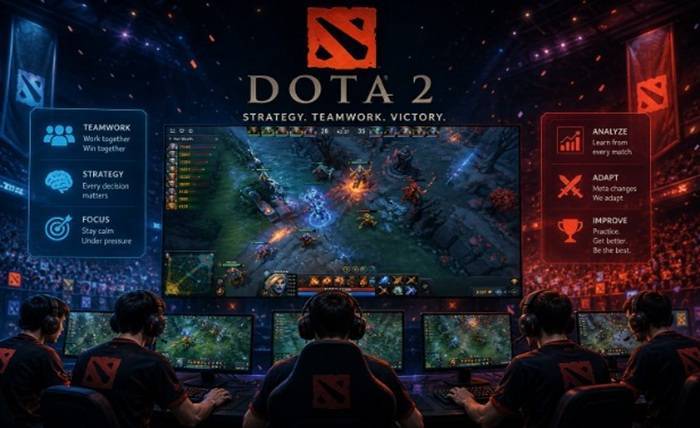
Very few competitive games manage to stay relevant for more than a decade, especially in an industry where trends change quickly and player attention often moves from one title to another within months. New genres appear every year, new mechanics become popular, and fresh releases constantly compete for the spotlight. Yet despite all of that, Dota 2 continues holding its place as one of the most respected competitive titles in modern gaming.
What makes this even more impressive is that Dota 2 has never relied on simplicity to keep players engaged. It has always demanded patience, learning, and adaptation. For many players, the first few matches can feel overwhelming. The number of heroes, item combinations, team strategies, map objectives, and timing decisions create a learning curve that is far steeper than most modern multiplayer games. But for the players who stay, that complexity becomes the biggest reason they never fully leave.
Competitive Depth Creates Long-Term Loyalty
One of the strongest reasons Dota 2 continues attracting serious players is its competitive depth. Every match creates a new puzzle. Hero drafts change the pace of the game. Lane matchups shape early momentum. Vision control, objective timing, positioning, and resource management can completely shift outcomes in ways that are difficult to predict.
Even after thousands of matches, experienced players often find themselves facing situations they have never encountered before.
That unpredictability creates long-term engagement.
Unlike games where strategies become repetitive over time, Dota 2 constantly rewards players who keep learning. A small positioning mistake can lose a team fight. A delayed item timing can change a late-game objective. A single smoke rotation can completely flip the momentum of an entire match.
This level of strategic pressure is one of the biggest reasons the community remains deeply invested year after year.
Player Mindset Has Evolved Beyond Winning
While casual viewers often focus only on highlight plays or final scoreboard results, long-term Dota 2 players usually pay attention to much deeper details. They study tempo control, draft flexibility, objective pressure, communication patterns, and how teams respond when momentum suddenly changes.
Winning still matters.
But understanding how a game is being won often matters just as much.
This mindset has influenced other competitive gaming communities as well. Across interactive gaming ecosystems, including entertainment-driven platforms such as slot gacor, experienced users often focus less on isolated outcomes and more on timing, rhythm, consistency, and behavioral patterns before making decisions.
That same analytical mindset is part of what keeps competitive gaming communities active and constantly evolving.
The Community Continues Driving The Game Forward
Another major reason Dota 2 remains relevant is its community. Few gaming communities analyze their game with the same level of intensity. Discussions about patch updates, meta shifts, hero balance, item efficiency, laning priorities, and tournament strategies happen every day across forums, streams, social platforms, and team discussions.
This creates an environment where learning never truly stops.
Players do not simply queue for matches and leave.
They review replays.
They study professional drafts.
They analyze mistakes.
They compare strategies.
They test new builds.
And through this process, they continue developing not only as players, but as thinkers.
That constant exchange of ideas is one of the biggest reasons Dota 2 continues feeling alive even after so many years.
Global Competition Keeps Standards High
Dota 2 has also built one of the most international competitive ecosystems in gaming. Players from different regions bring unique styles, priorities, and approaches to the game. Some regions play with faster aggression, others rely on disciplined macro play, and some build their identity around teamfight execution or late-game scaling.
This global diversity creates a competitive environment where adaptation becomes essential.
In international gaming ecosystems such as slot server thailand, players often compare not only individual performance, but also platform responsiveness, regional communication styles, and how different communities approach competition under pressure.
These comparisons create stronger players.
They also create stronger communities.
Because when players constantly interact with different playstyles and perspectives, the game itself continues evolving.
Pressure, Strategy, And Loyalty Define The Experience
At its core, Dota 2 survives because it offers something many games struggle to maintain—meaningful challenge. It demands concentration, emotional control, teamwork, communication, and the willingness to improve after failure.
Some matches feel effortless.
Some feel exhausting.
Some feel impossible.
And some become unforgettable.
That emotional range is what keeps so many players connected to the game for years.
People may join because of the competition, the strategy, or the esports scene. But many stay because few games create the same combination of pressure, satisfaction, frustration, and growth.
And as long as players continue valuing challenge over comfort, learning over shortcuts, and teamwork over instant rewards, Dota 2 will continue standing as one of the strongest competitive communities in modern gaming.